 To become a distributor











19Aug
137 Views
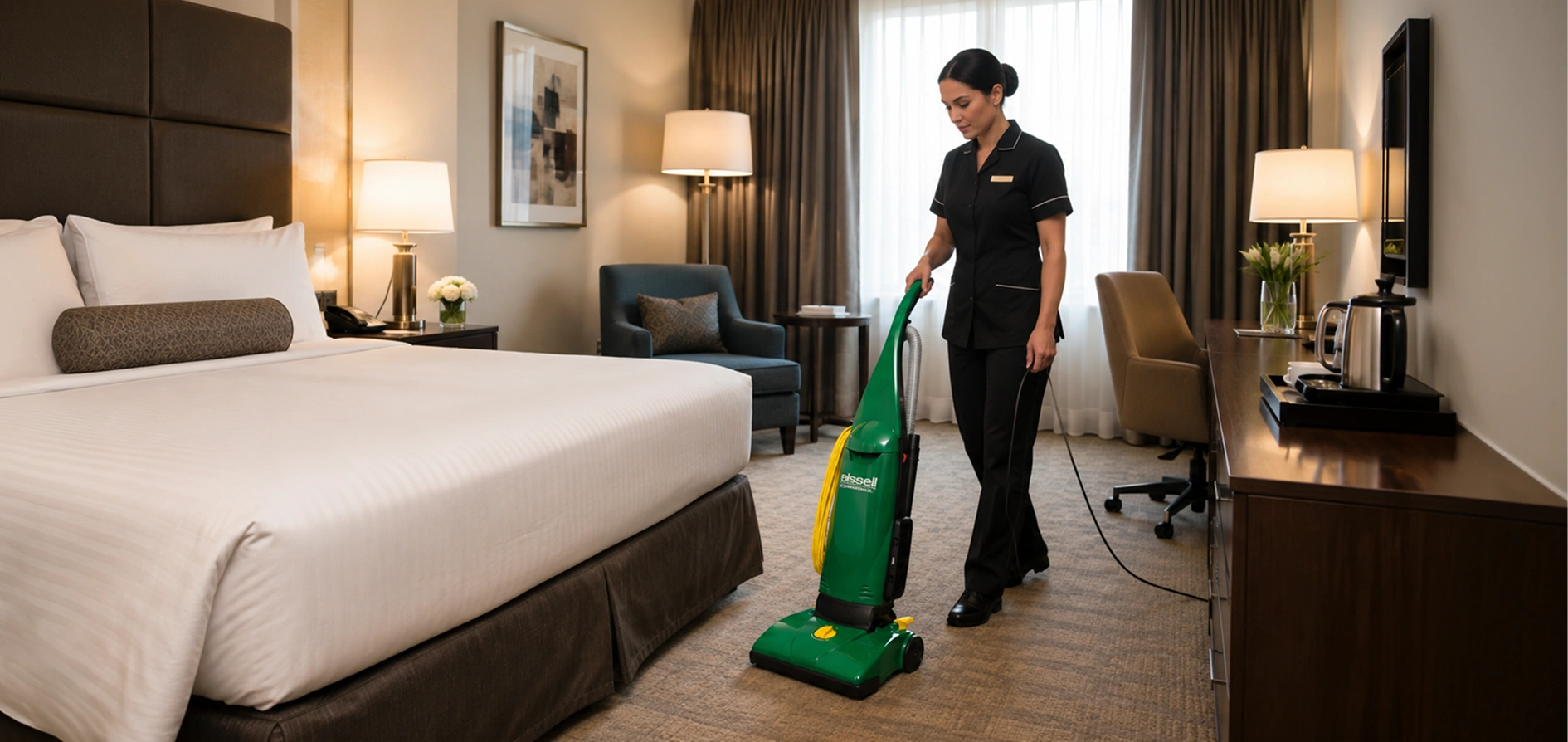
Clean Rooms, Faster Turns: Why the Right Hotel Vacuum Cleaner Is a Labor, Guest-Experience, and Sustainability Decision
Guests rarely ask what equipment your housekeeping team uses.
They simply notice the result.
They notice dust along the baseboards, debris near the bed, hair on the bathroom floor, or a carpet that looks tired even after the room has been cleaned. These details influence how guests judge cleanliness—and cleanliness influences how they judge the entire property.
That is why selecting a hotel vacuum cleaner should not be treated as a routine equipment purchase. The right machine affects room-turnaround time, staff fatigue, carpet life, indoor dust control, maintenance expense, and the consistency guests experience from one room to the next.
The buying question should not be:
“Which vacuum has the lowest price?”
It should be:
“Which vacuum can our team use effectively, repeatedly, and economically throughout the property?”
Cleanliness Has a Direct Operational Cost
The U.S. hotel industry expects guest spending to reach nearly $805 billion in 2026. Yet rising expenses continue to pressure profitability, with gross operating profit per available room still at roughly 90% of its 2019 level. In that environment, equipment that slows housekeeping or requires frequent replacement becomes more than a maintenance inconvenience. It becomes a margin issue.
South Carolina operators face the same pressure inside a strong tourism market. Tourism contributes an estimated $31 billion to the state economy, supports one in every ten jobs, and generates approximately $3.2 billion in state and local taxes. Properties in Myrtle Beach, Charleston, Hilton Head, Columbia, Greenville, Spartanburg, and interstate markets must maintain room standards while managing heavy seasonal and weekend traffic.
Consider a 100-room hotel operating at 70% occupancy. That represents approximately 25,550 occupied room-nights per year.
If an inefficient vacuum adds only two minutes to each occupied-room cleaning, the property could spend more than 850 additional housekeeping hours annually.
A few minutes per room do not look significant on a product sheet. Across an entire year, they matter.
The Best Hotel Vacuum Depends on the Job
There is no single machine that is automatically the best hotel vacuum for every property.
A limited-service motel with mostly carpeted rooms may prioritize a lightweight upright machine that moves quickly between rooms. A larger hotel may need separate equipment for guest rooms, corridors, hard floors, upholstery, and periodic deep extraction.
Before selecting a model, review:
- Flooring types throughout the property
- Average number of rooms cleaned per shift
- Stairs, elevators, and storage limitations
- Cord length and available outlets
- Noise during daytime or evening cleaning
- Dust capacity and emptying frequency
- Availability of bags, belts, filters, rollers, and fans
- Whether deep carpet extraction is also required
The Carpet and Rug Institute recommends daily commercial-grade vacuuming in heavy-traffic areas. Its Seal of Approval program evaluates equipment for soil removal, dust containment, and protection of carpet appearance. That matters because effective cleaning can help carpets remain presentable and useful for longer.
Weight Is a Productivity Specification
A vacuum may have impressive suction, but if it is difficult to lift, turn, carry, or move between floors, housekeeping teams will feel the difference every day.
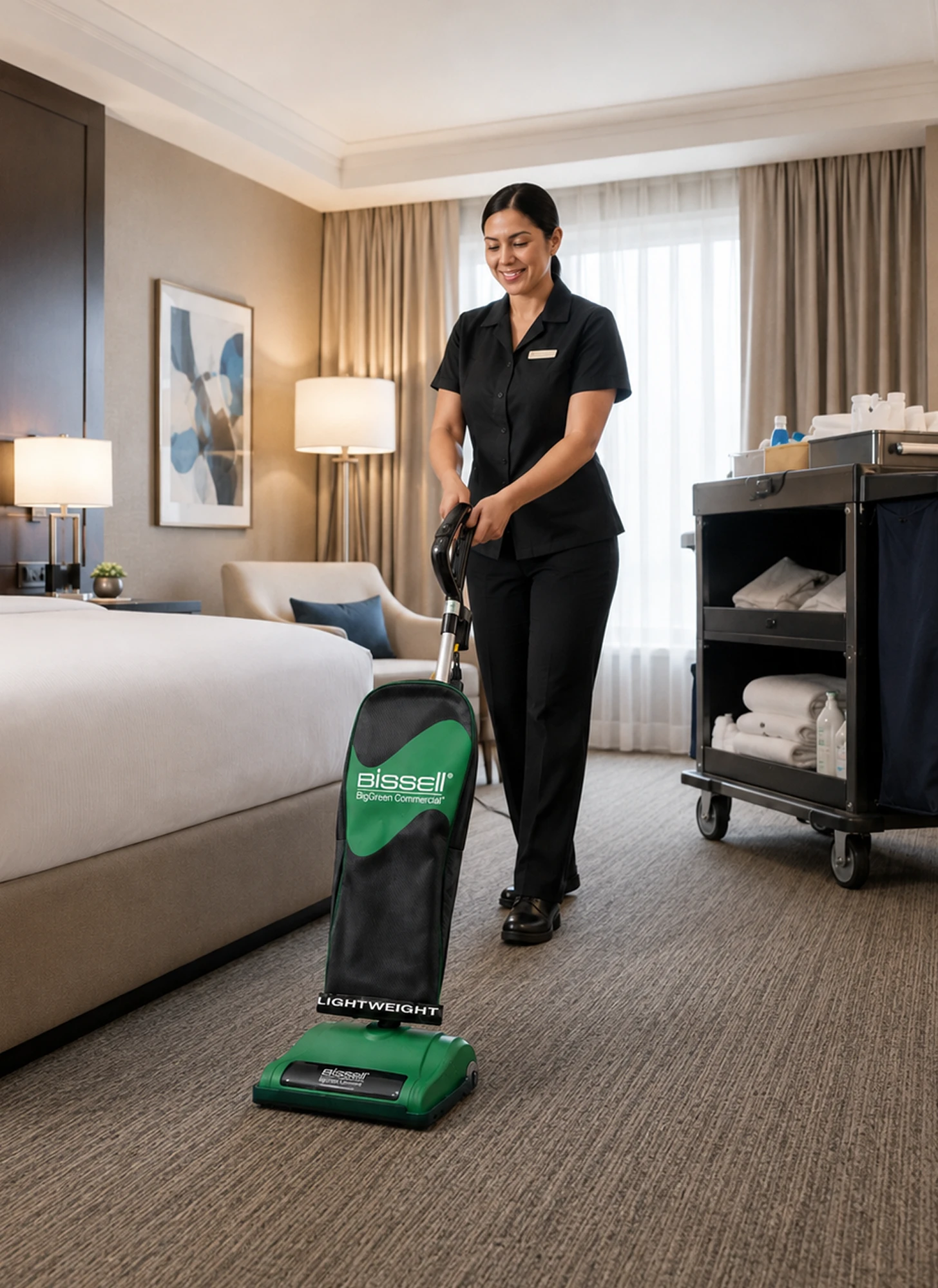
AGH Supply currently lists a Bissell lightweight commercial upright model weighing approximately eight pounds, with a 13-inch cleaning head, 40-foot cord, and self-adjusting transition between carpet and bare floors. Its Bissell ProCup upright is approximately 11.25 pounds without the cord and includes a 13.5-inch cleaning path, onboard tools, five height settings, three-stage filtration, and a 30-foot cord.
These specifications explain why buyers searching for lightweight commercial vacuum wholesale options should compare more than motor size.
Ask how frequently the machine will be carried. Test whether the handle feels comfortable. Check whether it lies low enough to reach under furniture and whether the cleaning head moves easily around beds, chairs, luggage racks, and nightstands.
A heavier machine may offer additional capacity or features, but it should earn that added weight through better performance for the intended task.
Cord Length and Cleaning Width Affect Room Turnaround
Stopping to change outlets wastes time.
A longer commercial cord can help a housekeeper clean more of the room or corridor without unplugging the machine. A wider cleaning path can reduce the number of passes required—but a machine that is too wide may become difficult to maneuver in smaller motel rooms.
Current hospitality-market options demonstrate the tradeoff. National Hospitality Supply lists lightweight commercial uprights around eight to twelve pounds, alongside quieter HEPA models weighing approximately 17 to 20 pounds. Guest Supply also carries commercially rated HEPA upright equipment designed for hotel rooms, hallways, and facility-maintenance environments.
Competitor variety is useful because it shows there is no universal specification. The goal is not to select the machine with the longest feature list. It is to select the combination of weight, reach, filtration, capacity, and maneuverability that fits the property.
Filtration Matters—but Read the Specification Carefully
Vacuuming removes visible dirt, but it can also disturb fine dust.
The EPA recommends considering a vacuum with a HEPA filter to reduce dust buildup and help prevent some collected particles from escaping back into the indoor air. A true HEPA vacuum must be designed so that all exhausted air passes through the HEPA filter; simply fitting a HEPA-style filter into an unsealed machine does not necessarily create equivalent performance.
For hotels, filtration decisions should reflect the environment.
A standard commercial vacuum may suit routine applications. A sealed HEPA system may deserve greater consideration in properties serving allergy-sensitive guests, operating in dust-prone areas, or completing renovation cleanup.
Bagged and bagless machines also present different tradeoffs. Bagged units can offer controlled disposal, while bagless systems reduce the need to purchase disposable bags. However, emptying a dust cup can release particles if it is handled carelessly.
There is no responsible reason to label one system “more sustainable” without considering maintenance, filtration, replacement consumption, and staff procedure.
When a Wholesale Industrial Vacuum Cleaner Is Necessary
Daily upright vacuuming and periodic deep cleaning are different jobs.
AGH’s Bissell BG10 commercial extractor uses separate solution and recovery tanks, dual motors, a 10-inch cleaning path, edge-to-edge suction, and forward-and-back cleaning. At approximately 42 pounds, it is not intended to replace a lightweight daily room vacuum. It is designed for deeper carpet-cleaning requirements.
A property evaluating a wholesale industrial vacuum cleaner or extractor should consider:
- Recovery-tank capacity
- Water removal and carpet drying time
- Cleaning-path width
- Transport between floors
- Staff training
- Upholstery-tool availability
- Storage and post-use cleaning
Buying a heavy-duty extractor for every housekeeper would be unnecessary. Depending on one lightweight upright for every cleaning situation would be equally unrealistic.
A stronger equipment plan assigns the right machine to the right task.
Sustainability Starts With Useful Life
The most sustainable vacuum is not automatically the machine with the smallest motor, washable filter, or bagless design.
It is often the machine that cleans effectively, protects carpet, remains repairable, and stays in service long enough to justify the materials and energy used to manufacture and transport it.
AGH’s current range includes replacement rollers, fans, and shake-out cloth bags for certain Sanitaire equipment. Access to compatible parts can help a property repair routine wear rather than discard an entire machine because of one failed component.
A practical sustainability policy should include:
- Cleaning or replacing filters on schedule
- Removing hair and thread from brush rolls
- Replacing belts before they damage other components
- Checking cords and plugs for safety
- Training staff to clear blockages correctly
- Matching the vacuum to the flooring
- Repairing serviceable components
- Retiring equipment only when performance or safety no longer meets requirements
Proper carpet maintenance can also support sustainability by helping flooring perform for its intended life instead of requiring premature replacement.
Buying Wholesale Vacuum Cleaners
Purchasing wholesale vacuum cleaners can create consistency across shifts and properties. Staff training becomes easier when teams use familiar controls, filters, bags, and replacement parts.
But do not bulk-order an untested machine.
Place one or two models into actual room service first. Track:
- Minutes required per room
- Staff feedback
- Cord and belt problems
- Bag or dust-cup capacity
- Performance on carpet and hard flooring
- Noise complaints
- Maintenance frequency
- Availability of replacement parts
A dependable motel supply partner should help compare models and applications rather than recommend the same machine to every property.
AGH Supply, based in West Columbia, South Carolina, carries selected Bissell and Sanitaire commercial vacuums, deep-cleaning equipment, and replacement components. The realistic value is not claiming that one listed model is perfect for every hotel. It is helping buyers distinguish between lightweight daily cleaning, multi-surface work, and periodic extraction needs.
The Bottom Line
Guests may never see your hotel vacuum cleaner.
They see everything it leaves behind.
The right equipment helps housekeeping teams move efficiently, maintain cleaner-looking rooms, control indoor dust, protect carpet, and reduce avoidable equipment replacement.
Do not buy only for suction.
Buy for usability, filtration, reach, repairability, flooring compatibility, and total cost over the machine’s working life.
In hospitality, the best cleaning equipment is not the machine with the most impressive description.
It is the one your team can depend on—room after room.
Better Choices, Better Results
Ready to Make Smarter Choices?
If you are reviewing your housekeeping setup, compare how your current vacuum performs in real daily use. The smartest upgrade is usually the one that saves time, reduces strain, and keeps room standards consistent.
Source Credits
- American Hotel & Lodging Association, 2026 State of the Industry Report.
- South Carolina Department of Parks, Recreation & Tourism, state tourism economic-impact information.
- U.S. Environmental Protection Agency, indoor particulate matter and HEPA-vacuum guidance.
- Carpet and Rug Institute, commercial carpet maintenance and Seal of Approval guidance.
- AGH Supply, commercial vacuum, extractor, and replacement-part listings.
- Competitor product specifications reviewed from National Hospitality Supply and Guest Supply.
Frequently Asked Questions
01 Is a lightweight commercial vacuum better for hotel housekeeping?
A lightweight commercial vacuum can be particularly useful when housekeeping staff carry equipment between rooms, floors, elevators, and storage areas. Lower weight can improve maneuverability and reduce staff fatigue during repetitive room cleaning. However, hotels should balance weight with cleaning performance, filtration, durability, cleaning path, cord length, and the property's flooring.
02 What specifications matter most when buying a hotel vacuum cleaner?
Important specifications include weight, cleaning path, cord length, filtration, dust capacity, maneuverability, noise, and flooring compatibility. Hotels should also check the availability of bags, belts, filters, rollers, fans, and other vacuum replacement parts. The ideal specification depends on whether the machine will primarily clean guest rooms, corridors, hard floors, or other areas.
03 How important is vacuum weight for hotel housekeeping staff?
Weight becomes especially important when staff repeatedly lift, carry, turn, or transport equipment throughout a shift. A heavier machine may provide useful capacity or additional features, but those advantages should justify the additional weight. Hotels should test equipment in representative guest rooms and evaluate how easily staff can maneuver it around beds, furniture, and tight spaces.
04 What maintenance should hotels perform on commercial hotel vacuum cleaners?
Housekeeping and maintenance teams should follow a routine inspection schedule covering filters, bags or dust cups, brush rolls, belts, cords, rollers, fans, and blockages. Hair and thread should be removed from brush rolls, filters cleaned or replaced as specified, and worn components replaced promptly. Staff training is important because incorrect maintenance can reduce performance and equipment lifespan.
05 How can hotels use commercial vacuum cleaners more sustainably?
Sustainability involves more than choosing a bagless machine or washable filter. Hotels should consider equipment lifespan, repairability, replacement consumption, maintenance, carpet lifespan, and cleaning efficiency. Keeping a commercial vacuum operational through appropriate replacement parts can avoid premature equipment disposal. Matching the machine to its intended task can also prevent unnecessary wear and replacement.
06 What should hotels consider when choosing a commercial hotel vacuum cleaner?
Hotels should evaluate flooring, room volume, cleaning time, machine weight, cleaning path, cord length, filtration, dust capacity, maneuverability, noise, and replacement-part availability. The right commercial hotel vacuum cleaner should match the property's daily housekeeping workload rather than simply offer the highest suction or lowest purchase price.
07 Can the right commercial hotel vacuum cleaner improve guest experience?
Guests judge cleanliness by what remains visible after housekeeping finishes. Effective vacuuming helps remove dust, hair, debris, and soil from rooms and floors, supporting cleanliness perception and guest satisfaction. Reliable equipment can also help housekeeping teams maintain consistent standards during busy periods. The operational objective is not simply better equipment, but consistently cleaner rooms with efficient room turnaround.