 To become a distributor

































07Aug
150 Views
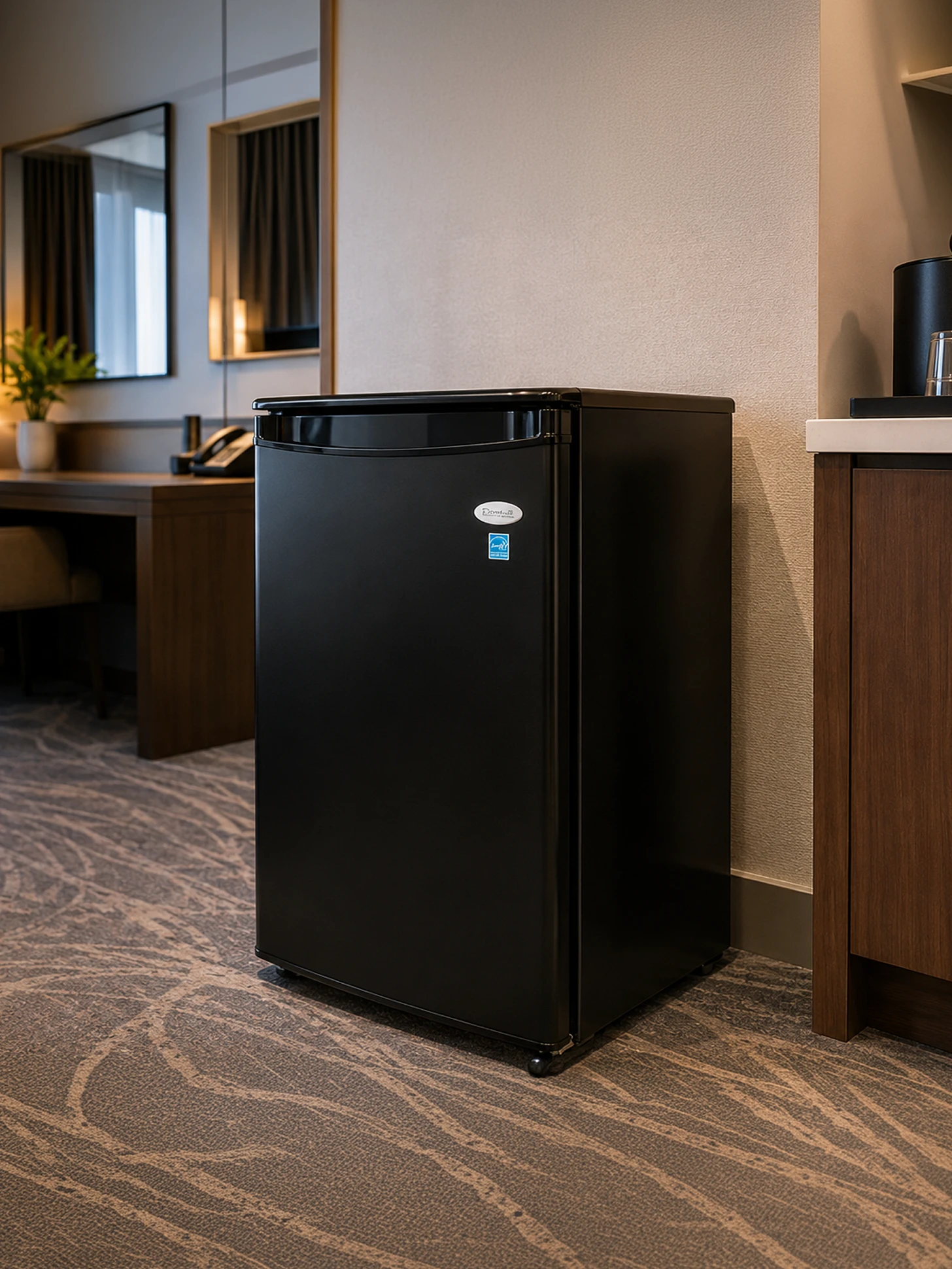
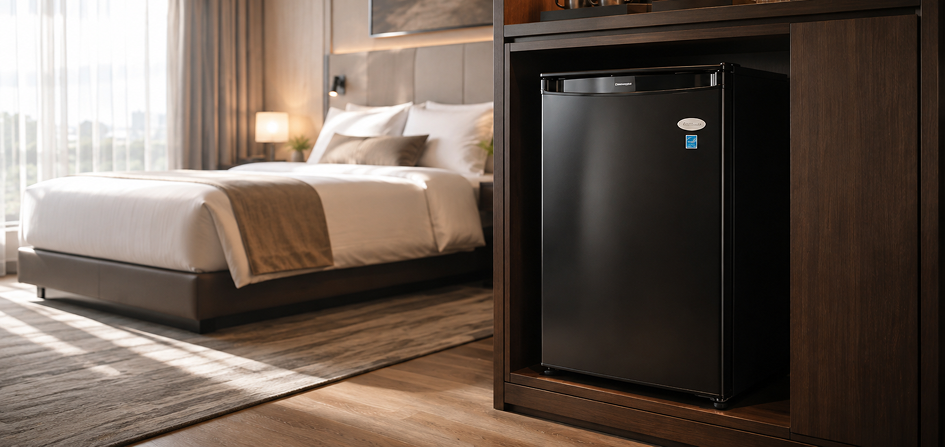
The Quiet Amenity Guests Notice: Why the Right Hotel Mini Fridge Protects Reviews, Energy Costs, and Room Revenue
A guest may never compliment the refrigerator in the room.
But they will notice when it is noisy, warm, difficult to open, covered in frost, or too small to hold a few drinks and leftovers.
That is what makes a hotel mini fridge different from many other guest-room purchases. When it performs correctly, it quietly adds convenience. When it does not, it creates front-desk calls, maintenance work, replacement costs, and negative impressions.
For hotel and motel owners, the buying decision should not begin with:
“Which unit has the lowest price?”
It should begin with:
“Which refrigerator will work reliably in this room, for this guest, over several years?”
That question matters even more as hotel operating costs continue to rise. The American Hotel & Lodging Association expects U.S. hotel guest spending to reach nearly $805 billion in 2026, while rising expenses continue to keep hotel profitability below pre-pandemic performance levels.
In South Carolina, the opportunity is substantial. Tourism has an estimated $31 billion annual economic impact, supports approximately 240,000 jobs, and generates more than $3 billion in state and local taxes.
More travelers mean more occupied rooms—and more demand for guest-room conveniences that work consistently.
A Hotel Room Refrigerator Is No Longer an Extra
Today’s guests travel with more than clothing.
They may carry restaurant leftovers, children’s snacks, beverages, meal-prep items, baby food, or temperature-sensitive products. Business travelers may stay for several nights, while families visiting Myrtle Beach, Charleston, Hilton Head, Columbia, Greenville, or interstate destinations often value the ability to store basic food and drinks in the room.
A working hotel room refrigerator can reduce unnecessary trips to the lobby, vending machine, convenience store, or front desk.
But simply placing any compact appliance in the room is not enough.
Hotel owners should confirm whether they are purchasing a true refrigerator or primarily a beverage cooler. The distinction matters because the U.S. Food and Drug Administration recommends keeping refrigerators at or below 40°F for safe food storage.
If a unit is designed only to cool beverages, it may not be appropriate for guests who assume they can safely store perishable food.
That creates a simple operational rule:
Know what the
appliance is designed to do—and communicate that clearly to the guest.
Size Should Match the Stay
One of the first decisions is capacity.
Hospitality-supply catalogs currently include compact models ranging from approximately 1.0 cubic foot to 3.6 cubic feet. Common hotel-focused options include 1.7-, 2.2-, 2.6-, 3.2-, and 3.6-cubic-foot units.
The correct size depends on your property.
A one-night roadside motel may only need enough space for bottled water, a few cans, and a takeout container.
An extended-stay property may need larger shelving, door storage, and enough internal space for several days of food.
Before selecting a hotel refrigerator, ask:
- How long does the average guest stay?
- Are families or business travelers common?
- Will the unit sit inside a cabinet?
- Is freezer space genuinely necessary?
- Can housekeeping clean and inspect it easily?
- Will the door open correctly in the planned location?
A larger unit is not automatically a better purchase. It takes up more room and may use more energy. A unit that is too small, however, may disappoint guests and encourage overloading.
Energy Use Multiplies Across Every Room
A refrigerator operates continuously, not only when the room is occupied.
That means a small difference in annual energy use becomes significant when multiplied across an entire property.
ENERGY STAR states that certified compact refrigerators use approximately 30% less measured energy than minimum federal efficiency standards. Its current product listings include compact units with annual consumption near 106 to 125 kilowatt-hours, although actual use varies by model, capacity, room temperature, installation, and guest behavior.
Consider the scale.
A model rated at 106 kilowatt-hours per year would represent approximately 10,600 kilowatt-hours annually across 100 rooms.
That does not automatically tell you which model to purchase. It shows why owners buying bulk refrigerators should compare the energy label—not only the purchase invoice.
The cheapest unit to buy may not be the cheapest unit to operate.
Noise Can Turn Convenience Into a Complaint
Guest-room appliances must operate differently from appliances placed in an office, break room, or staff kitchen.
A refrigerator positioned only a few feet from the bed can become noticeable at night.
Compressor cycling, vibration, rattling shelves, door movement, and cabinet resonance may disturb light sleepers. Some hospitality-focused units use absorption or superconductor cooling systems designed for quieter operation. Guest Supply, for example, lists a compact hospitality refrigerator featuring silent absorption cooling, auto defrost, an adjustable shelf, a reversible hinge, and an optional lock.
Quiet operation, however, should not be evaluated in isolation.
Hotel owners must balance:
- Cooling performance
- Noise level
- Energy consumption
- Maintenance requirements
- Purchase cost
- Expected service life
Test a sample unit in an actual room before purchasing dozens or hundreds of units.
Listen to it at night.
Check its temperature after the door has been opened several times.
Place bottles and containers inside to confirm that the shelves are practical.
A specification sheet cannot fully reproduce the guest-room experience.
Installation Details Affect Performance
A quality hotel mini fridge can still perform poorly if installed incorrectly.
Compact refrigerators need appropriate ventilation. A unit placed tightly inside furniture without sufficient airflow may retain heat and work harder. Flat-back designs can simplify placement, while reversible doors offer more flexibility when room layouts vary.
Competitor catalogs show that hotel-focused products commonly include features such as reversible doors, auto defrost, adjustable shelves, flat-back construction, interior lighting, and door storage.
Before ordering, measure more than the visible opening.
Confirm:
- Appliance width, depth, and height
- Door-swing clearance
- Electrical-outlet location
- Ventilation space
- Cabinet interior dimensions
- Housekeeping access
- Floor protection and leveling
For South Carolina properties—especially in warmer coastal markets—proper airflow and regular inspection become even more important when units are enclosed in cabinets.
Maintenance Determines the Real Cost
A refrigerator may look like a one-time capital expense, but the real cost includes cleaning, service calls, room downtime, replacement parts, and eventual disposal.
Housekeeping teams should have a simple inspection routine:
- Check that the unit is cooling.
- Remove abandoned food.
- Wipe spills promptly.
- Inspect the gasket.
- Confirm that the door closes properly.
- Look for frost, moisture, odor, or unusual noise.
A neglected hotel room refrigerator can quickly become a cleanliness issue. A well-maintained one becomes an amenity guests use without thinking twice.
That is the goal.
Choosing a Supplier for Bulk Refrigerators and Hotel Electronics
Buying one appliance is easy.
Buying appliances for 50, 100, or 200 rooms requires better planning.
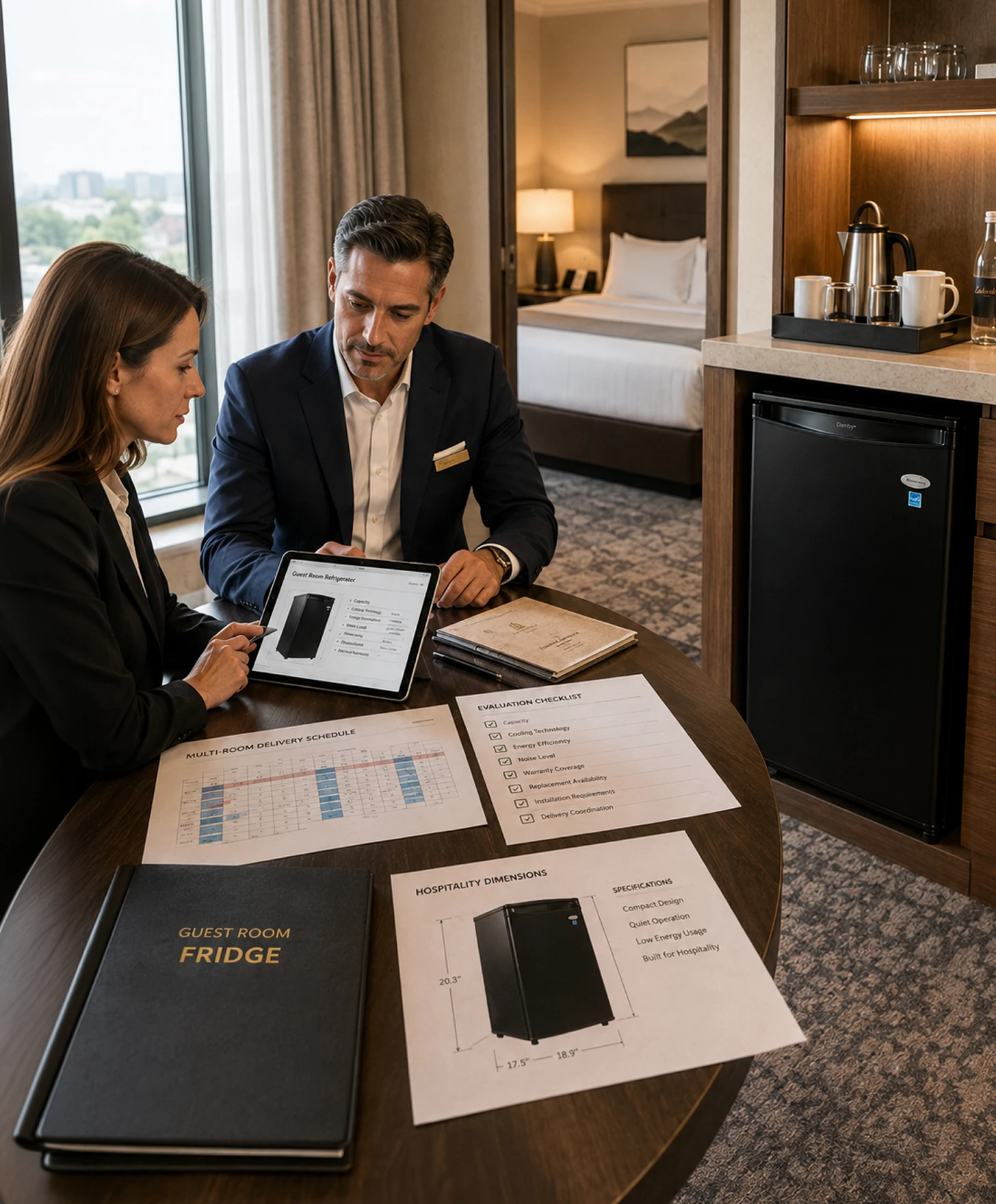
A dependable supplier of hotel electronics should help you compare more than brand names. The conversation should include capacity, cooling technology, energy consumption, noise, warranty, replacement availability, installation requirements, and delivery coordination.
Large hospitality suppliers offer broad refrigerator selections, which gives buyers useful choices but can also make comparison more complicated. AGH Supply’s role should be practical: helping owners identify what fits the property rather than pushing every customer toward the same model.
When evaluating a supplier, ask:
- Can the same model be supplied for future room replacements?
- What happens if the selected model is discontinued?
- Are dimensions and electrical requirements clearly documented?
- Can the supplier support a phased renovation or multi-property order?
- Are alternative models available without changing the entire room setup?
- Is the product intended for hospitality use?
The Bottom Line
A hotel mini fridge is a small appliance with property-wide consequences.
It affects guest convenience, maintenance calls, electricity use, room design, and replacement planning.
The best unit is not necessarily the largest, quietest, or least expensive model.
It is the one that matches your guest profile, performs reliably inside your room layout, and delivers predictable value over time.
For hotel and motel owners, that is the real purchasing standard:
“Do not buy the refrigerator that looks best on the order sheet.
Buy the one that creates the fewest
problems after installation.”
Better Choices, Better Results
Ready to Make Smarter Choices?
If you are reviewing your guest-room amenities, compare your hotel refrigerators as long-term operational investments. That usually gives a clearer picture of what is helping your property perform well and what may need upgrading.
Source Credits:
• American Hotel &
Lodging Association, 2026 State of the Hotel Industry.
• South Carolina Department of Parks, Recreation & Tourism, tourism research
and 2026 industry updates.
• U.S.
Environmental Protection Agency, ENERGY STAR refrigerator criteria and certified-product listings.
• U.S. Food and Drug Administration, refrigerator-temperature and food-storage
guidance.
• Hospitality product specifications reviewed from Guest Supply and National Hospitality Supply.
Frequently Asked Questions
01 What size hotel room refrigerator is best for a hotel or motel?
The right size depends on guest needs and average length of stay. A 1.7- or 2.2-cubic-foot hotel room refrigerator may suit short-stay properties, while extended-stay hotels may benefit from larger models. Before purchasing, consider guest demographics, cabinet dimensions, door clearance, storage needs, and whether freezer space is actually necessary.
02 What is the difference between a hotel mini fridge and a beverage cooler?
A hotel mini fridge is generally intended to provide refrigerated storage, while some beverage coolers are primarily designed to chill drinks. This distinction matters because guests may expect a hotel room refrigerator to safely store perishable food. Hotels should verify the appliance's intended use and communicate appropriate storage guidance clearly to guests.
03 Are energy-efficient hotel mini refrigerators worth the investment?
Yes, particularly for properties with dozens or hundreds of guest rooms. A refrigerator operates continuously, so even modest differences in annual energy consumption can multiply across a hotel property. Comparing energy ratings alongside purchase price helps procurement managers understand the total hotel refrigerator operating cost rather than focusing only on the initial invoice.
04 Should hotels buy hotel mini fridges in bulk?
Bulk purchasing can improve procurement efficiency when a hotel, motel, or resort is outfitting multiple rooms or replacing aging equipment. Standardizing models can simplify ordering, maintenance, staff training, and replacement parts. Working with an experienced hospitality supplier can also help coordinate larger orders and maintain consistent equipment across the hotel property.
05 How does a hotel mini refrigerator affect the guest experience?
A clean, quiet, reliable guest room refrigerator adds convenience for storing beverages, snacks, medication that can safely be refrigerated, or other appropriate items. When the appliance works properly and is well maintained, it supports guest satisfaction. Conversely, odors, excessive noise, poor cooling, or dirty interiors can negatively affect perceptions of hotel quality.
06 What should hotels look for when buying a hotel mini refrigerator?
Hotels should evaluate capacity, cooling performance, energy consumption, noise level, ventilation requirements, durability, maintenance needs, and expected service life. The right hotel mini refrigerator should match the property's guest profile and room layout. A reliable unit can improve guest convenience while reducing maintenance calls, replacement costs, and unnecessary hotel operating expenses.
07 What maintenance does a hotel mini refrigerator require?
Housekeeping staff should routinely check cooling performance, remove abandoned food, clean spills, inspect the door gasket, confirm proper door closure, and look for frost, moisture, odors, or unusual noise. Regular inspection helps identify problems before they become guest complaints or expensive repairs, while also supporting cleanliness and consistent guest satisfaction.